Technical SEO Checklist 2026: Core Web Vitals, Schema & Crawlability
Any Technical SEO Checklist 2026 worth following has to start from an uncomfortable fact: more than half the web is still technically broken in ways that actively suppress rankings, and most site owners have no idea which half they're on. Only 55.7% of web origins pass all three Core Web Vitals thresholds as of early 2026, 43% of sites still fail the Interaction to Next Paint (INP) responsiveness metric, and more than 60% of sites using schema markup have at least one validation error blocking them from rich results entirely. Technical SEO isn't the exciting part of search; it's the plumbing
But in 2026 it's also become the entry ticket to AI-generated answers, since Google AI Overviews, ChatGPT, and Perplexity all evaluate the same technical quality signals before deciding what to cite.
This checklist walks through Core Web Vitals, schema markup, and crawlability in order, with real case data and an actionable framework you can run again
Why This Technical SEO Checklist 2026 Matters More Than Ever?
Technical SEO used to be a ranking factor among many. In 2026, it's also the mechanism that determines whether AI systems can read your site at all. Pages that fail Core Web Vitals thresholds tend to surface less frequently in AI-generated search results, and structured data schema markup is now a primary source Google's AI pulls from when assembling AI Overview answers.
This is entity SEO in practice: schema markup is literally how you tell Google and AI crawlers exactly what entity your page represents — a business, a product, an article, a person — rather than leaving them to infer it from unstructured text. Get the technical foundation wrong, and even excellent content struggles to be found, understood, or cited by either traditional search or the newer generative layer sitting on top of it.
What's the Complete Technical SEO Checklist 2026?
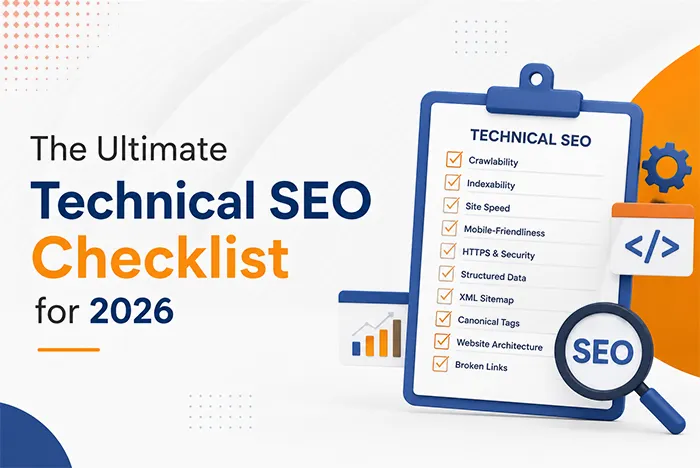
Run this condensed version against your own site as a fast audit: LCP under 2.5s, INP under 200ms, CLS under 0.1 — verified in Search Console's Core Web Vitals report, not just a lab tool.
Organisation, Article, FAQPage, Product, or LocalBusiness schema implemented and validated with zero errors. Clean, current robots.txt with no accidental disallows on important sections.
XML sitemap submitted in Search Console and free of broken or non-canonical URLs.
Correct canonical tags on every duplicate or near-duplicate page.
Zero orphan pages — every important page reachable through internal links.
Site-wide HTTPS with no mixed-content warnings.
Search Console's Index Coverage report checked monthly for crawl and indexing errors.
Part 1: The Core Web Vitals Checklist (LCP, INP & CLS)
Core Web Vitals are three field metrics Google measures from real Chrome users — not lab tests — at the 75th percentile over a rolling 28-day window:
Metric Measures Good Threshold Poor Threshold LCP (Largest Contentful Paint) Loading speed Under 2.5 seconds Over 4.0 seconds INP (Interaction to Next Paint) Responsiveness Under 200 milliseconds Over 500 milliseconds CLS (Cumulative Layout Shift) Visual stability Under 0.1 Over 0.25
INP fully replaced First Input Delay (FID) as the responsiveness metric in March 2024, and it's structurally harder to pass — it measures the delay across every interaction on a page, not just the first one, which is exactly why 43% of sites still fail the 200ms threshold in 2026.
Checklist for each metric: ✅ LCP: Preload your largest above-the-fold image, inline critical CSS, preload key fonts with font-display: swap, and consider server-side rendering for JavaScript-heavy pages. ✅ INP: Break long JavaScript tasks into smaller chunks, defer non-critical scripts, and yield to the main thread between interactions. ✅ CLS: Set explicit width and height on every image, video, and iframe, and reserve space for dynamically loaded content and ads.
The payoff is measurable. Sites that pass all three thresholds see roughly 24% lower bounce rates, and one documented case saw a tech publisher improve LCP from 3.9 seconds to 1.9 seconds and CLS from 0.3 to 0.08 — within three months, organic traffic grew by 22%. That's not a coincidence; it's what happens when you stop losing visitors (and Google's confidence) to a slow, jumpy page. Worth noting: mobile pass rates trail desktop by roughly 7 percentage points, with only around 47–48% of mobile sites passing all three thresholds compared to 56% on desktop — if you're only testing on desktop, you're likely overestimating how your site actually performs for the majority of real visitors.
Part 2: The Schema Markup Checklist for 2026
Schema markup (structured data) tells search engines and AI systems explicitly what your content is, rather than leaving them to guess from formatting and context. It's one of the biggest gaps in this entire checklist: only 44% of top 1,000 global websites use structured data at all, and of those that do, more than 60% have at least one validation error that blocks rich-result eligibility entirely — meaning simply implementing schema correctly already puts you ahead of most competitors.
The five highest-leverage schema types for 2026:
Organisation — your entity foundation; include sameAs links to your social profiles and other verified web presences. Article / BlogPosting — for editorial and blog content, with nested author (Person) schema. FAQPage — direct question-and-answer pairs, ideal for both featured snippets and AI Overview extraction. Product — for e-commerce, including price, availability, and review data. LocalBusiness — for any business with a physical location or defined service area. Checklist steps:
✅ Implement schema in JSON-LD format. ✅ Validate every schema block with Google's Rich Results Test and the Schema.org Validator before publishing. ✅ Monitor the Enhancements report in Google Search Console for ongoing errors and rich-result performance. ✅ Re-validate after every site redesign or CMS update — schema breaks silently more often than any other technical element.
The upside is real and documented. One brand launched from a blank domain with zero backlinks and zero historical traffic, but built a full structured data layer from day one — Organisation, Product, BlogPosting, BreadcrumbList, and FAQPage schema across the site. Six months later: nearly 668,000 impressions, close to 6,800 clicks, an average position of 4.5, a 5,329% impression growth rate, and an AI Overview citation — achieved with structured data as the foundation, not an afterthought bolted on later.
Part 3: The Crawlability & Indexability Checklist None of the above matters if Googlebot and AI crawlers can't reach your pages in the first place. Crawlability is the foundation every other technical SEO effort sits on top of. Checklist steps:
✅ Audit robots.txt. Read it like a compliance document — most robots.txt files haven't been reviewed since before AI crawlers existed, and accidentally disallowed high-value directories are a common, costly mistake. ✅ Maintain and submit an XML sitemap. A sitemap doesn't guarantee indexing — it's an invitation, not an instruction — but it significantly improves crawl efficiency, especially on larger sites. ✅ Fix canonical tags. Every duplicate or near-duplicate page needs a correct canonical pointing to the preferred version, or you risk splitting ranking signals across multiple URLs. ✅ Eliminate orphan pages. Any page with too few (or zero) internal links pointing to it is effectively invisible to crawlers, no matter how good the content is. ✅ Enforce HTTPS everywhere. It's been a confirmed ranking signal since 2014 and is now a baseline expectation, not a differentiator — sites still running HTTP in 2026 face both ranking penalties and visible browser trust warnings. ✅ Check server logs when possible. Log file analysis reveals crawl frequency, which bots are actually visiting, and status code patterns (302s, 404s, 500s) that Search Console alone won't always surface.
The business case for getting this right is concrete. One documented case involved a service business that optimized its XML sitemap by topic cluster and cleaned up a messy robots.txt file — Googlebot began indexing new service-area pages within 48 hours instead of the previous two-to-three-week delay. Over the following six months, that business's organic revenue grew from roughly $11,200 to between $63,000 and $84,000 per month — a roughly 5.6× increase, driven largely by pages that simply couldn't get discovered and indexed fast enough before the fix.
Frequently Asked Questions About Technical SEO Checklist 2026
What's the single highest-priority item on a Technical SEO Checklist 2026? Crawlability comes first, structurally — if Google and AI crawlers can't access your pages, nothing else on this checklist matters. After that, Core Web Vitals and schema markup both carry significant, measurable weight.
How often should I re-run a technical SEO audit? At minimum quarterly, and immediately after any site redesign, CMS migration, or major content push — schema and crawl configuration both tend to break silently during these changes.
Do Core Web Vitals really affect rankings, or just user experience? Both. Core Web Vitals are a confirmed Google ranking signal, though they typically act as a tie-breaker between pages of similar content quality rather than overriding relevance outright. Their bigger, more consistent impact is on conversions and bounce rate.
Is schema markup necessary if I already rank well? Yes, increasingly. Schema doesn't just support rich results in traditional search — it's a primary signal AI Overviews and other generative engines use to understand and cite your content, which matters even for pages that already rank well organically.
What's the fastest technical SEO win for a small business site? Fixing crawlability issues (robots.txt and sitemap errors) and implementing basic Organisation and LocalBusiness schema usually deliver the fastest visible improvement, since both are often completely missing rather than just suboptimal.
Where can I learn technical SEO, schema, and Core Web Vitals properly? Look for training that treats technical SEO as a full module, not a footnote — covering crawling, indexing, canonical tags, Core Web Vitals, and schema markup together. Chyweb Academy's SEO Training Programme includes a dedicated Technical SEO module covering exactly this ground.
What tools do I need to run through this checklist myself? Google Search Console and PageSpeed Insights cover Core Web Vitals reporting; Google's Rich Results Test and the Schema.org Validator cover structured data; and Screaming Frog SEO Spider is the standard tool for auditing crawlability, robots.txt, canonical tags, and orphan pages at scal
Final Word
A real Technical SEO Checklist 2026 isn't a nice-to-have addendum to content strategy — it's the infrastructure that determines whether your content gets found, understood, and cited at all, by Google or by the AI systems increasingly standing between your business and the customer. With just 55.7% of sites passing Core Web Vitals and only 44% of top sites using schema at all,
the businesses that work through this checklist properly aren't chasing a marginal edge — they're fixing gaps most competitors haven't even noticed yet. Start with crawlability, layer in Core Web Vitals fixes, then build out schema markup, and revisit all three every quarter.
If you want structured, hands-on training across all three pillars, Chyweb Academy's SEO Training in Nigeria covers technical SEO as a core part of its curriculum.